

Holy Mackerel! Why This Fish Deserves More Attention

Mackerel Deserves a Place on Your Plate

Fresh whole grilled mackerel with caramelized onions, charred asparagus, grilled tomato, lemon, and arugula — simple ingredients, bold flavor, and real nourishment.
Mackerel is one of the world’s most widely consumed fish—and for good reason. Long before “superfoods” became trendy, cultures around the world were already enjoying oily fish like mackerel for their rich flavor and incredible nutrition. Whether fried, baked, steamed, or grilled, this flavorful fish delivers essential nutrients in abundance and health benefits in every bite.
Know the difference!

Their differences come on different layers: taste, flavor, size, types, price, shelf life, and the culinary world.
Taste and Flavor
Mackerel and salmon are both oily fish. Mackerel is less salty than salmon, and has an authentic buttery ocean taste. Some describe it as close to tuna. Salmon, on the other hand, has fleshier meat and has an authentic smoky taste.
Size
The average size of a mackerel fish is small compared to salmon. Mackerel are 12 inches (30 cm) on average, whereas salmon are larger than that on average.
Types
There are over 30 types of mackerel that are very similar to one another, although many differences do exist between them. On the other hand, there are fewer types of salmon than mackerel; most varieties are within the pacific types.
Price
Salmon is a much more expensive fish than mackerel. Salmon may cost as much as five-eight times more than mackerel. When smoked the salmon gets even more expensive.
Shelf life
Mackerel has a shorter shelf life as the skin spoils rather quickly. Consequently, mackerel must be deep frozen for storage for extended freshness. Salmon has a comparably longer shelf life. Yet it also needs to be refrigerated promptly, or frozen for long term storage.
Culinary world

In many cultures, mackerel is often available in cured and pickled forms in the market. They are of course available as fresh; however, fresh mackerel has to be eaten fairly quickly, within a day or two, or otherwise be frozen for storage immediately after being caught. Different varieties of foods can be prepared with mackerel, for example, fried, pan-grilled, chargrilled, added to rice, and can even be consumed pickled and cured.
On the other hand, salmon has even a wider variety of usages. Salmon is consumed raw, most notably in Japanese sushi. They can also be grilled and smoked before being served as a salmon steak. Salmon can also be found in soups and warm dishes in European countries.
🧬 Nutrition Showdown

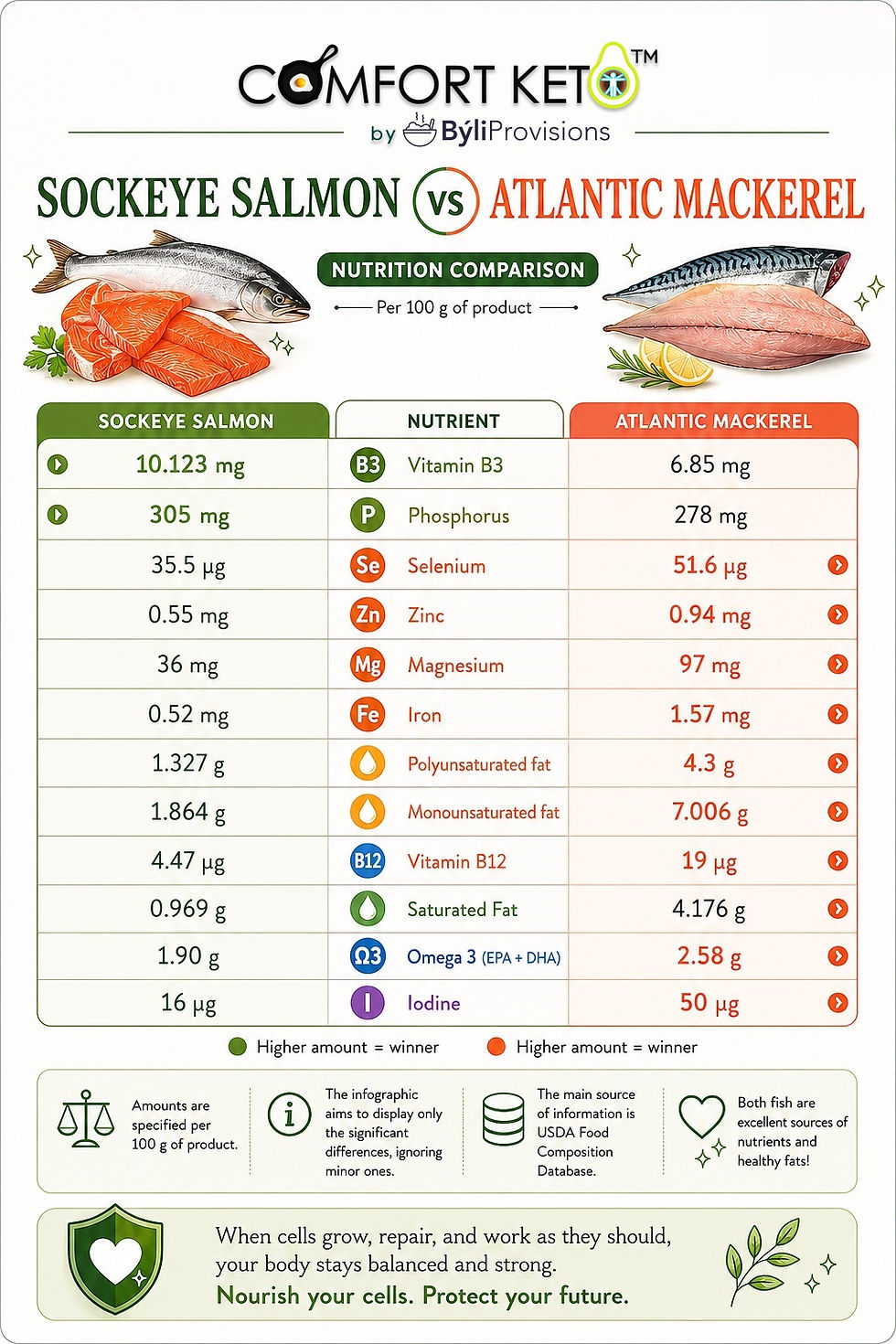
💡 Why Start Eating Mackerel Now? Here Are Some Reasons Why You Should ...
❤️ Supports Healthy Blood Pressure & Heart Health
Mackerel is rich in potassium and healthy omega-3 fats that help support healthy blood pressure, circulation, and overall heart function.
Regularly eating mackerel may help:
support healthy cholesterol levels,
improve circulation,
relax blood vessels,
reduce strain on the heart,
and help lower inflammation within the cardiovascular system.
Because mackerel is naturally high in beneficial fats and important minerals, it may help reduce the risk of:
high blood pressure,
hardened arteries,
heart attack,
stroke,
and other cardiovascular complications.
For people following a low-carb or ketogenic lifestyle, mackerel is an excellent nutrient-dense food that helps replenish important minerals and healthy fats often needed on keto.
Other potassium-rich foods include:
salmon,
red meat and chicken,
Greek yogurt and cheese,
avocados,
mushrooms,
kale,
mustard greens,
and radishes.
Supporting heart health also involves proper hydration, stress management, minimizing processed foods, and maintaining a nutrient-rich diet.
🩸 Helps Support Healthy Blood Sugar Levels
Mackerel contains healthy fats and high-quality protein that may help support more stable blood sugar levels and improved metabolic health.
Unlike highly processed carbohydrate-rich foods that can rapidly spike blood sugar, fatty fish like mackerel digest more slowly and help the body maintain steadier energy levels.
The healthy monounsaturated fats (MUFAs) and omega-3 fats found in mackerel may help:
improve insulin sensitivity,
reduce inflammation,
support healthier metabolism,
and reduce excessive fat storage around the abdomen and internal organs.
Excess visceral fat — the deeper fat stored around the organs — is strongly associated with:
insulin resistance,
type 2 diabetes,
fatty liver,
and cardiovascular disease.
Including nutrient-dense foods like mackerel in a lower-carbohydrate lifestyle may help reduce blood sugar spikes and support better long-term metabolic control.
For many people following a ketogenic or low-carb lifestyle, fatty fish like mackerel can be an excellent food choice because it provides:
healthy fats,
important minerals,
satisfying protein,
and stable energy without raising blood sugar significantly.
Reducing processed sugars, refined starches, and ultra-processed foods while increasing whole nutrient-rich foods is one of the most effective ways to support healthier blood sugar balance naturally.
🦴 Helps Support Joint Health & Reduce Inflammation
Mackerel is rich in omega-3 fatty acids that help support joint health and may help reduce inflammation throughout the body.
People struggling with rheumatoid arthritis, joint stiffness, or chronic inflammation may benefit from regularly including oily fish like mackerel, salmon, sardines, herring, and anchovies in their diet.
Omega-3 fats are known for their anti-inflammatory properties and may help:
reduce joint pain,
ease stiffness,
improve mobility,
and support healthier joint function over time.
Modern diets high in processed seed oils and industrial vegetable oils tend to contain excessive omega-6 fatty acids, which may contribute to increased inflammation when consumed in large amounts and without proper omega-3 balance.
Replacing ultra-processed foods with nutrient-dense whole foods and omega-3-rich fish may help support a healthier inflammatory response in the body.
Maintaining a healthy weight is also important for joint health, since excess body fat — especially visceral fat — can place additional stress on joints and contribute to inflammatory conditions.
For people following a low-carb or ketogenic lifestyle, fatty fish like mackerel can be an excellent anti-inflammatory food choice that supports both metabolic and joint health.
🧠 Supports Brain Health & Cognitive Function
Mackerel is rich in omega-3 fatty acids — especially DHA (Docosahexaenoic Acid) — an important fat that plays a major role in brain health, memory, mood, and nervous system function.
DHA is one of the primary structural fats found in the brain and is essential for healthy communication between brain cells.
Regularly eating omega-3-rich fish like mackerel may help:
support memory and concentration,
improve mental clarity,
support emotional well-being,
and help maintain healthy brain function as we age.
Research has also linked higher omega-3 intake with lower rates of depression and mood-related disorders. Many people report more stable mood and improved mental well-being when regularly consuming nutrient-dense foods rich in healthy fats.
Because chronic inflammation and metabolic dysfunction are increasingly associated with cognitive decline, diets rich in omega-3 fats and lower in ultra-processed foods may help support long-term neurological health.
Some studies also suggest that regular consumption of oily fish rich in DHA may help support healthier aging of the brain and may lower the risk of neurodegenerative conditions associated with aging.
For people following a low-carb or ketogenic lifestyle, fatty fish like mackerel can be especially valuable because the brain relies heavily on healthy fats for proper function and energy support.
🧬 Supports Immune Health & Healthy Vitamin D Levels
Mackerel is one of the few natural food sources rich in vitamin D — an essential nutrient that plays an important role in immune function, bone health, inflammation control, and overall wellness.
Many people today are deficient in vitamin D, especially those who spend little time in direct sunlight or consume highly processed diets.
Vitamin D is important because it helps support:
immune system function,
calcium absorption and bone strength,
healthy inflammatory response,
and normal cellular function throughout the body.
Research has also shown that maintaining healthy vitamin D levels is associated with better overall health outcomes and may play a supportive role in long-term wellness and recovery during serious illnesses.
Fatty fish like mackerel, salmon, sardines, and herring are among the best natural dietary sources of vitamin D and are excellent additions to a nutrient-dense lifestyle.
For people following a low-carb or ketogenic diet, mackerel is especially valuable because it provides:
healthy fats,
high-quality protein,
omega-3 fatty acids,
and fat-soluble vitamins like vitamin D in a highly bioavailable form.
Combining nutrient-rich foods, regular sunlight exposure, proper sleep, and minimizing ultra-processed foods can all help support healthier vitamin D levels naturally.
🛒Where to Buy Fresh Mackerel in Riverside County
Super Seafood Asian Market
Address: 4513 La Sierra Ave., Riverside, CA 92505
Phone: (951) 588-8288
Notes: Excellent whole fish selection with strong Filipino and Southeast Asian seafood inventory. Very good option for whole mackerel.
99 Ranch Market
Address: 430 McKinley St., Corona, CA 92879
Phone: (951) 898-8899
Notes: Reliable source for fresh and frozen whole mackerel with high seafood turnover.
99 Ranch Market
Address: 4956 Hamner Ave., Eastvale, CA 91752
Phone: (951) 585-8899
Notes: Large newer location with strong seafood department and consistent fish inventory.
88 Ranch Marketplace
Address: 27473 Ynez Rd., Temecula, CA 92591
Phone: (951) 694-6821 and (951) 587-8988
Notes: Convenient Southwest Riverside County option. Call ahead for current whole mackerel inventory.
88 Ranch Neighborhood Market
Address: 4131 Oceanside Blvd., Oceanside, CA 92056
Phone: (760) 643-2269
Notes: Hours: 8AM - 8PM
Based on our experience, 88 Ranch Marketplace has one of the largest and freshest seafood selections in Riverside County.
Their seafood department carries a wide variety of items that are difficult to find at most other local markets — from live blue crab and sushi-grade yellowfin tuna to fresh whole mackerel and many other specialty seafood items.
One unique feature is that customers can even have their fish freshly fried and then sit down and enjoy it in the market’s dining area. Fresh whole fish is served at both their Temecula and Oceanside locations.
The market has also recently undergone remodeling, and the seafood department is now back in operation — cleaner, more modern, better organized, and offering an improved shopping experience overall.
🔥 Pro Tip: Avoid farmed salmon due to health and environmental concerns. Stay tuned—we'll dive deeper into th e topic of farmed salmon soon!

Hopefully by now, you have at least a basic understanding that there is far more to mackerel than simply living in the shadow of salmon.
From its rich omega-3 content and impressive nutritional value to its bold flavor, affordability, and versatility in the kitchen, mackerel truly deserves more appreciation on the modern dinner table.
And now — you even know where to find fresh whole mackerel right here in Riverside County. 🐟🔥
Bon Appétit!
Chef Janine.


Comments