

Sunflower Oil: One of the Better Seed Oils, But Still Not the Best Choice

Sunflower oil is often promoted as one of the healthiest cooking oils available. It is rich in vitamin E and widely used in home kitchens, restaurants, and thousands of processed foods.
The variety of sunflower used, the way the oil is extracted, how it is refined, and even how long it has been sitting on the shelf all influence its stability and nutritional quality. While conventional sunflower oil is high in fragile Omega-6 polyunsaturated fats that oxidize relatively easily, high-oleic sunflower oil offers a more stable alternative.
This article explains the different types of sunflower oil, how they are produced, what makes some versions better than others, and why—even in its best form—sunflower oil still falls short of naturally stable fats such as extra virgin olive oil, avocado oil, coconut oil, butter, ghee, and tallow.
What Are Seed Oils?
Seed oils are vegetable oils extracted from the seeds of plants. Common examples include sunflower, canola (rapeseed), soybean, corn, cottonseed, safflower, grapeseed, rice bran, sesame, and peanut oils.

Because they come from plants, seed oils are technically classified as vegetable oils. However, not all vegetable oils are seed oils. Oils obtained from the fruit of plants—such as olive, avocado, and coconut oil—are also vegetable oils but are not considered seed oils.
Most commercial seed oils are extracted and refined using industrial processes that may include solvent extraction, refining, bleaching, and deodorization. These processes help produce a clear, neutral-tasting oil with a long shelf life, but they also distinguish modern seed oils from minimally processed oils such as extra virgin olive oil or cold-pressed avocado oil.
Sunflower oil belongs to the seed oil family, but not all sunflower oils are the same. The variety of sunflower, the method of extraction, and the degree of processing all have a major impact on the oil's stability and overall quality.
The Two Types of Sunflower Oil
Not all sunflower oils are created equal. The nutritional properties and cooking performance of sunflower oil depend largely on the type of sunflower from which it is produced.
Traditional (High-Linoleic) Sunflower Oil
This is the original form of sunflower oil and the one most commonly used in processed foods. It is rich in Omega-6 polyunsaturated fats (linoleic acid), which makes it relatively unstable when exposed to heat, light, and oxygen. As a result, it is more susceptible to oxidation during processing, storage, and cooking.
High-Oleic Sunflower Oil
High-oleic sunflower oil is produced from specially bred sunflower varieties that naturally contain much more oleic acid, the same monounsaturated fat that contributes to olive oil's stability. It is not genetically modified; the plants were developed through conventional plant breeding.
Because of its higher monounsaturated fat content and lower Omega-6 level, high-oleic sunflower oil is considerably more resistant to oxidation than traditional sunflower oil. For this reason, it is the preferred choice whenever sunflower oil is used.
Even so, high-oleic sunflower oil is still a seed oil. While it is one of the better options within its category, it remains more processed and less naturally stable than traditional fats such as extra virgin olive oil, avocado oil, coconut oil, butter, ghee, or tallow.
How Sunflower Oil Is Made
Sunflower oil can be extracted in two very different ways. The method used has a significant impact on the oil's nutritional quality, flavor, and resistance to oxidation.
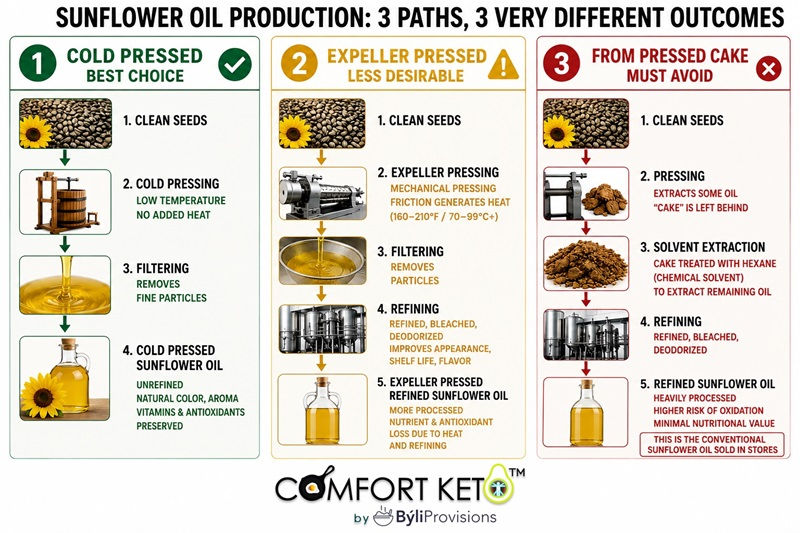
Cold-Pressed Sunflower Oil
Cold pressing mechanically extracts oil from sunflower seeds without the use of chemical solvents or externally applied heat. The slight increase in temperature is a natural consequence of mechanical pressing. As a result, the oil retains more of its natural flavor, aroma, vitamin E, and other naturally occurring plant compounds.
Cold-pressed sunflower oil has a mild, clean, slightly nutty flavor with subtle toasted notes. Rather than tasting like sunflower flowers, it resembles the delicate flavor of fresh sunflower seeds. High-oleic varieties are generally even milder, making them an excellent choice for salad dressings, vinaigrettes, dips, and other recipes where the oil contributes to the overall flavor without overpowering the dish.
Because cold-pressed sunflower oil is minimally processed, it is best purchased in small, dark glass bottles that can be used within a relatively short period after opening. Smaller, dark bottles reduce the oil's exposure to air and light, helping preserve its flavor, aroma, and nutritional quality at their best.
Refined Sunflower Oil
Refined sunflower oil begins with mechanical pressing. The remaining seed cake is then treated with a food-grade solvent to recover most of the oil still trapped within it. The combined oil from both extraction stages is refined, bleached, and deodorized to produce the clear, neutral-tasting oil commonly found on supermarket shelves.
This is the process used to produce most consumer-grade sunflower oil. Although sunflower oil is one of the easiest seed oils to extract through mechanical pressing alone, commercial producers generally choose refining because it recovers most of the oil remaining in the seed cake, making the process much more profitable on an industrial scale. Extended shelf life, a consistent appearance, and a neutral flavor provide additional economic advantages for manufacturers and retailers.
These benefits come with trade-offs. The refining process removes most of the naturally occurring compounds. It also exposes the oil to higher temperatures than cold pressing. Together, these factors increase the likelihood of oxidation over time.
How to Choose the Best Sunflower Oil
For sunflower oil to be as safe as possible:
👉 Choose cold-pressed, high-oleic varieties in dark glass
👉 Most commercially bottled sunflower oils have a labeled shelf life of about 12 months, although high-oleic oils may be labeled for longer.
👉 Buy a bottle pressed within the last 1–3 months (if the production date is available).
👉 Prefer bottles less than six months from production whenever possible. For cold-pressed oils, fresher is better—ideally within six months of pressing.
👉 Production date ≈ Best By Date – 12 months
Example:
Best By: December 2026
Estimated production: December 2025 (assuming a 12-month shelf life)
Today (June 2026): The oil is already about 6 months old. If a fresher bottle is available, choose that one.
Bottom-Line Verdict on Sunflower Oil
✅ If you must use a seed oil, high-oleic sunflower oil is one of the better options — but only under strict conditions.
Meaning:
High-oleic, NOT high-linoleic
Cold-pressed, not refined
Fresh (recent production date)
In small, dark glass bottles
Stored in a cool, dark place
Used only for low-to-medium heat cooking
Consumed in moderation
Not an ideal oil for deep frying
Under those ideal conditions, sunflower oil is significantly less prone to oxidation than other seed oils such as soy, corn, canola, cottonseed, safflower, or grapeseed.
High-oleic, cold-pressed sunflower oil is a good choice for dressings, light sautéing, and moderate-temperature cooking—but it is not an ideal oil for deep frying.

One example is Tessemae's, which uses organic, cold-pressed, high-oleic sunflower oil in its salad dressings instead of conventional refined seed oils. This oil is far more resistant to oxidation than traditional high-linoleic sunflower oil and reflects a higher-quality ingredient choice.
While extra virgin olive oil remains the gold standard for most cold applications, Tessemae's demonstrates that not all sunflower oils are created equal and that selecting a cold-pressed, high-oleic variety is a considerably better option than the refined sunflower oils commonly found in processed foods.
❗ But important reality check:
Even a high-quality seed oil is still a seed oil.
Its Omega-6 content is still higher than what humans evolved eating. Even cold-pressed versions oxidize faster than natural fats like:
olive oil
avocado oil
coconut oil
butter / ghee
tallow
So while cold-pressed sunflower oil is better than most seed oils, it is still not an optimal everyday fat.
Bon Appétit!
Chef Janine


Comments