

Ancel Keys: The Oceanographer Who Started the Chronic Illness Epidemic

Updated: Jun 21
Ancel Keys, one of the most influential figures in nutrition policy during the mid-20th century, played a pivotal role in promoting the idea that dietary saturated fats such as butter and lard were the primary cause of heart disease. Indirectly paid by sugar industry lobbyists, his work heavily influenced public health guidelines for decades.
Ancel Keys and the Sugar Industry
Keys' "Cherry-Picked" Research
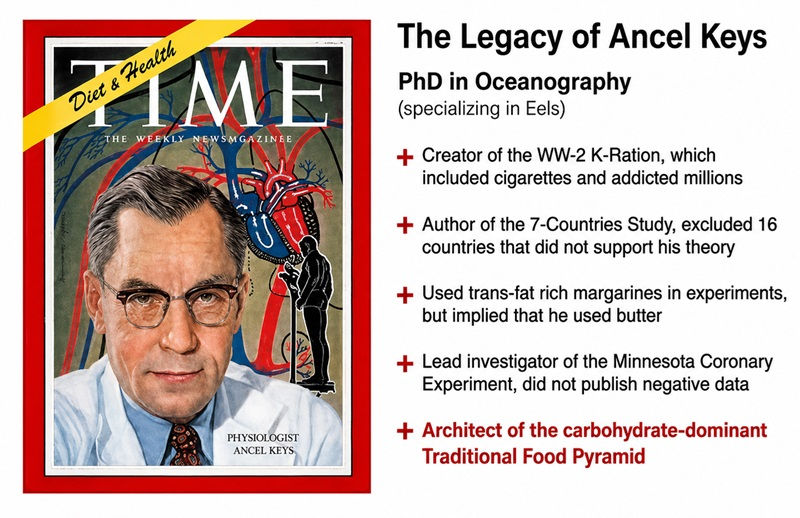
Keys is best known for his Seven Countries Study, which examined the relationship between diet, lifestyle, and cardiovascular disease. This study became the foundation for the belief that saturated fat causes heart disease.
However, Keys' research has been criticized for "cherry-picking" data. Although he initially examined data from 22 countries, he included only the seven countries that supported his hypothesis.
The Sugar Industry Connection
In the 1960s, it came to light that the Sugar Research Foundation (now the Sugar Association) paid prominent Harvard scientists, including Dr. Frederick Stare and Dr. Mark Hegsted, to downplay the role of sugar in heart disease and shift the blame to dietary fats.
These efforts, revealed in 2016 through historical documents, influenced public health policy and scientific discourse for decades, diverting attention from sugar's role in chronic disease.
Impact on Dietary Guidelines
The combination of influential research and sugar industry involvement helped cement low-fat, high-carbohydrate diets in U.S. dietary guidelines and contributed to the prominence of the carbohydrate-heavy food pyramid.
What We Know Today
Modern research has challenged many of these earlier claims, showing that:
Sugar and refined carbohydrates play a significant role in the development of obesity, type 2 diabetes, and heart disease.
Healthy fats, such as those found in avocados, nuts, seeds, and olive oil, can be part of a healthy diet and do not inherently contribute to heart disease when consumed in moderation.
This evolving understanding has led to a re-evaluation of public health recommendations and increased scrutiny of dietary advice promoted during Keys' era.
Timeline of Key Events
The major events related to the sugar industry's influence on dietary science and the shift of blame toward dietary fat occurred during the 1960s.
1965: The Sugar Research Foundation (SRF) paid prominent Harvard scientists, including Dr. Mark Hegsted and Dr. Frederick Stare, the equivalent of approximately $50,000 in today's dollars to conduct a literature review. The review was intended to downplay the role of sugar in heart disease and place greater emphasis on saturated fat as the primary dietary cause.
1967: The scientists published their review in the prestigious New England Journal of Medicine (NEJM). The review concluded that fats and cholesterol were the primary dietary causes of heart disease while minimizing the role of sugar. At the time, the journal did not require disclosure of conflicts of interest, so the sugar industry's funding was not revealed.
The narrative promoted by this research had lasting effects, influencing the development of low-fat, high-carbohydrate dietary guidelines during the 1970s and 1980s, including the creation of the carbohydrate-heavy food pyramid in 1992.
These connections became widely known in 2016, when historical documents were uncovered and published in JAMA Internal Medicine, revealing the sugar industry's role in shaping dietary science.
Our Perspective
In our view, few individuals have had a more damaging influence on modern nutrition than Ancel Keys.
What makes this story remarkable is that Keys was not even a trained physician, cardiologist, or nutrition specialist. His academic background was oceanography and eel physiology, yet his carefully manufactured narrative went on to shape dietary policies affecting billions of people around the world.
To us, this raises an obvious question: How did a man with such a background come to wield enormous influence over nutrition policy and public health recommendations?
As seen on the cover of Time magazine, Keys became famous for claiming that saturated fat was the primary cause of heart disease. His work, particularly the Seven Countries Study, served as the foundation for decades of low-fat dietary advice. Data supporting his agenda was highlighted. Data that challenged it was left out.
His work, particularly the Seven Countries Study, served as the foundation for decades of low-fat dietary advice. His engineered study selectively used data that supported his narrative while denying and later suppressing conflicting evidence. This was not scientific disagreement. This was the deliberate manipulation of health policy, and the consequences were enormous.
As governments embraced low-fat dietary guidelines, food manufacturers rushed to remove fat from their products. Wherever possible, fat was replaced with sugars, whole grains were replaced with refined carbohydrates, and traditional foods gave way to highly processed ingredients.
The result was a dramatic transformation of the modern food supply. With it came a half-century epidemic of obesity, type 2 diabetes, and other chronic illnesses at levels that would have been unimaginable just a few generations earlier.
The war on fat started by Keys laid the groundwork for these problems to spiral out of control. What followed was the rise of a sickness-management industry generating enormous profits from diseases that continue to expand to this day.
Ancel Keys is the central figure behind the greatest nutritional failures of the modern era. Others may see him as a scientist. We see Ancel Keys as a corrupt psychopath whose nefarious actions reshaped the global food system in the worst possible way and whose influence continues to affect public health to this day.
What cannot be denied is that Ancel Keys changed the way the world eats. Decades later, we are still living with the consequences of his deeds.


Comments