

The Failed Food Pyramid: The Nutrition Policy That Left America Sick

The traditional Food Pyramid, which emphasizes a carbohydrate-dominant diet with grains as its foundation, has faced significant criticism over the years. Ancel Keys, a nutrition policymaker during the mid-20th century, was a central figure in the development and promotion of the dietary philosophy that ultimately led to the carbohydrate-dominant Food Pyramid, despite his lack of formal education and expertise in nutrition science.
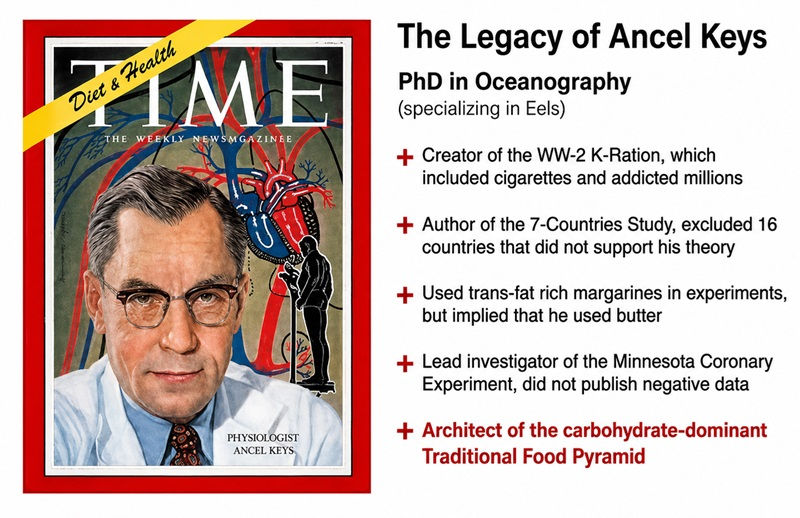
In 2016, damaging evidence published in a Journal of the American Medical Association (JAMA) study revealed that Keys was connected to efforts funded by the sugar industry and played a pivotal role in promoting the idea that dietary fat—particularly saturated fat—was the primary cause of heart disease. His work heavily influenced public health policy and dietary guidelines for decades, helping shift Americans toward a low-fat, high-carbohydrate dietary model.
That influence remained deeply embedded in federal nutrition policy until Spring 2026, when the new dietary guidelines were officially released by the USDA under the leadership of Robert F. Kennedy Jr., HHS Secretary, signaling a departure from the assumptions that shaped the carbohydrate-dominant recommendations of the past.

The Timeline
The Food Guide Pyramid was officially released by the U.S. Department of Agriculture (USDA) in April 1992 during the administration of President George H. W. Bush. Designed as the federal government's primary nutrition education tool, the pyramid encouraged Americans to build their diets around carbohydrate-rich foods, with bread, cereal, rice, and pasta forming the foundation of daily intake.
Before its release, however, the pyramid became the subject of significant controversy. Several agricultural and food-industry groups objected to how poorly certain products were represented in the original design, resulting in delays, revisions, and considerable political debate. The final version was ultimately released in 1992 after extensive review and negotiation.
For more than a decade, the traditional Food Guide Pyramid served as the nation's primary visual guide to "healthy eating." In 2005, it was replaced by MyPyramid, and in 2011 by MyPlate. Although the graphics and presentation evolved over time, both successors remained rooted in the same fundamental dietary philosophy established by the original 1992 pyramid—a carbohydrate-dominant model that emphasized grains as the cornerstone of a healthy diet.
The influence of the 1992 Food Pyramid extended far beyond government publications. Its recommendations fundamentally reshaped America's food system, influencing school nutrition programs, public health campaigns, food manufacturing, grocery shelves, restaurant menus, and the eating habits of generations of Americans. In doing so, it became the most destructive federal dietary guidance in U.S. history.
Key Issues with the Traditional Food Pyramid
The traditional Food Pyramid was officially retired in Spring 2026 and no longer serves as the federal government's dietary guidance model. For decades, it promoted a carbohydrate-dominant approach to nutrition that failed to align with the metabolic needs of many Americans. Its emphasis on grains and other carbohydrate-rich foods shaped public health policy, nutrition education, and eating habits across generations, despite growing concerns about its role in the rise of obesity, type 2 diabetes, and other metabolic disorders.
Below are some of the most commonly cited concerns.
1. Excessive Carbohydrate Intake
Blood Sugar Spikes and Insulin Resistance
A diet centered on refined carbohydrates such as white bread, pasta, cereal, and other processed grains can contribute to frequent blood sugar spikes and elevated insulin levels. Over time, this may increase the risk of insulin resistance, prediabetes, and type 2 diabetes.
Fat Storage
When consumed in excess, carbohydrates—particularly refined carbohydrates—are readily stored as body fat, contributing to weight gain and obesity.
2. Neglect of Nutrient-Dense Foods
The Food Pyramid places less emphasis on nutrient-dense foods such as quality proteins, healthy fats, and non-starchy vegetables. These foods provide essential vitamins, minerals, amino acids, and fatty acids that are critical for overall health and are often underconsumed in carbohydrate-heavy diets.
3. Generalized Recommendations
One-Size-Fits-All Approach
The pyramid was designed as a broad population guideline and does not account for differences in metabolism, activity level, age, body composition, or underlying health conditions. Individuals with insulin resistance, metabolic syndrome, or type 2 diabetes may benefit from a lower-carbohydrate approach than the pyramid recommends.
Potential for Carbohydrate Overconsumption
The recommended grain servings can encourage excessive carbohydrate intake without adequate consideration of portion size, carbohydrate quality, or individual metabolic health.
4. Underemphasis on Healthy Fats
The traditional pyramid often grouped all fats together and encouraged their limitation. As a result, many people reduced their intake of healthy fats from foods such as avocados, nuts, seeds, olives, and olive oil. These foods play important roles in brain function, hormone production, cellular health, and nutrient absorption.
5. Encourages Refined Grain Consumption
Although whole grains were intended to be part of the recommendation, many consumers interpreted the pyramid's grain-heavy foundation as an endorsement of processed and refined grain products. These foods typically contain less fiber and fewer nutrients than their whole-food counterparts.
6. Links to Chronic Disease
High-carbohydrate diets dominated by refined grains and added sugars have been associated with obesity, type 2 diabetes, cardiovascular disease, and certain forms of cancer. These conditions were historically less common in populations consuming diets based primarily on whole, minimally processed foods.
7. Based on Outdated Dietary Science
The Food Pyramid reflects a nutritional philosophy that emerged during the latter half of the twentieth century, when dietary fat and cholesterol were widely viewed as primary drivers of heart disease. More recent research has challenged many of these assumptions and has drawn greater attention to the potential health risks associated with excessive sugar and refined carbohydrate consumption, while recognizing the importance of healthy fats in a balanced diet.
Modern Alternatives
Low-Carbohydrate and Ketogenic Diets
Low-carbohydrate and ketogenic dietary approaches reduce carbohydrate intake while emphasizing healthy fats and adequate protein. By limiting foods that rapidly raise blood sugar levels, these approaches are designed to support improved blood sugar control, enhanced metabolic flexibility, and effective weight management.
Mediterranean Diet
The Mediterranean diet emphasizes whole, minimally processed foods, including vegetables, olive oil, nuts, fish, and other quality protein sources. While it includes grains, they are typically consumed in moderation and alongside healthy fats and nutrient-dense foods. The Mediterranean diet is widely recognized for its association with cardiovascular health, longevity, and overall well-being.
A Shift Toward Metabolic Health
Modern nutritional approaches increasingly focus on food quality, nutrient density, metabolic health, and individual needs rather than relying on a one-size-fits-all, carbohydrate-dominant model. Reducing reliance on refined carbohydrates while emphasizing whole foods, healthy fats, quality proteins, and vegetables may better support long-term health and help reduce the prevalence of obesity, type 2 diabetes, and other diet-related chronic diseases.


Comments