

Creatine: More Than a Bodybuilding Supplement

For decades, creatine has been associated with bodybuilders, athletes, and gym culture. In reality, creatine is one of the most extensively studied nutritional compounds in existence and benefits extend far beyond the weight room.
Creatine helps your cells produce energy, supports muscle growth and recovery, preserves strength and physical function as we age, and may even support brain function and cognitive performance.

Far from being an exotic supplement, creatine is a compound your body naturally produces and that is also found in foods such as red meat and fish.
What Is Creatine?
Creatine is a compound your body naturally produces and uses every day as part of its energy production system. Your liver, kidneys, and pancreas produce approximately 1 to 2 grams per day.
About 95% of the body's creatine is found in skeletal muscle, where it helps supply energy during muscular activity. The remaining 5% supports the brain, heart, and other tissues.
How Creatine Works
Every cell in the body relies on a molecule called ATP (adenosine triphosphate) for energy. ATP stores are extremely small and can be depleted within seconds during intense activity such as sprinting, lifting weights, climbing stairs, or even standing up from a chair.
Creatine phosphate acts as a rapid energy reserve. It donates a phosphate group to regenerate ATP almost instantly, allowing muscles and other tissues to continue producing energy during periods of high demand.
Think of creatine as the body's emergency battery pack for short bursts of energy.
Creatine and Muscle Growth
Creatine is one of the few supplements consistently shown to increase lean muscle mass.
It supports muscle growth through several mechanisms:
Increased training performance and workload.
Improved recovery between sets.
Increased cellular hydration within muscle tissue.
Enhanced muscle protein synthesis signaling.
Improved ability to maintain training intensity over time.
The result is greater gains in muscle size and strength when combined with resistance training.
Cellular Hydration
Creatine also increases the amount of water contained within muscle cells. This is one reason muscles look fuller and more defined shortly after beginning supplementation.
This additional hydration becomes part of the muscle tissue itself, where it supports normal cellular function, energy production, recovery, and growth.
Because many people mistake this for bloating, it is worth taking a closer look at what is actually happening.
Does Creatine Cause Bloating?
One of the most common concerns about creatine is that it causes bloating or puffiness.
Creatine does increase the amount of water within muscle tissue, but that is not the same thing as the type of fluid accumulation people usually mean when they talk about bloating.
The important question is not whether creatine increases the amount of water in muscles — it does. The important question is where that water is stored and what role it plays once it gets there.

In the case of creatine, the additional water becomes part of the muscle tissue itself and contributes to normal muscle function, energy production, recovery, and growth.
This is one reason muscles often appear fuller and firmer after creatine supplementation.
By contrast, the bloating people worry about occurs when excess fluid accumulates outside cells and between tissues, leading to swelling or puffiness.
Most people have experienced this type of bloating firsthand:
Swollen ankles or feet after a long flight or a long day on their feet.
Tight rings or puffy fingers after a particularly salty meal.
Facial puffiness after a poor night's sleep.
A bloated or uncomfortable feeling after a very large meal.
Temporary water retention associated with hormonal changes.
These are the experiences most people think of when they hear the term bloating.
Creatine works differently.
During the first few weeks of supplementation, muscles gradually absorb additional creatine. As they do, additional water accompanies it and becomes incorporated into the muscle tissue itself.
As a result, many people notice a modest increase in body weight during this period.
This does not represent body fat gain. Instead, it reflects the increased hydration of muscle tissue.
This additional hydration supports normal muscle function, energy production, recovery, and adaptation to exercise.
The Bottom Line
Creatine does not cause the soft, puffy appearance people associate with bloating. Instead, it increases the hydration of muscle tissue itself, often resulting in fuller, firmer, and stronger-looking muscles.
Creatine and Strength
Numerous studies have demonstrated improvements in:
Maximum strength
Explosive power
Sprint performance
Repeated high-intensity efforts
Resistance training capacity
For this reason, creatine supplementation is common among athletes participating in strength and power sports.
Creatine and Brain Health
The brain is one of the body's most energy-demanding organs. Emerging research suggests creatine may support cognitive function, mental fatigue resistance, memory, and performance during periods of sleep deprivation or high mental demand.
Researchers are currently investigating possible roles for creatine in neurodegenerative diseases and traumatic brain injury recovery.
Creatine and Ketogenic Diets
Creatine works independently of carbohydrates and insulin, making it fully compatible with ketogenic and low-carbohydrate lifestyles. In fact, ketogenic eaters already consume more creatine than average because red meat and seafood are among the richest dietary sources.
For individuals who exercise regularly or who consume limited amounts of animal products, supplementation can help ensure optimal creatine stores.
Food Sources of Creatine
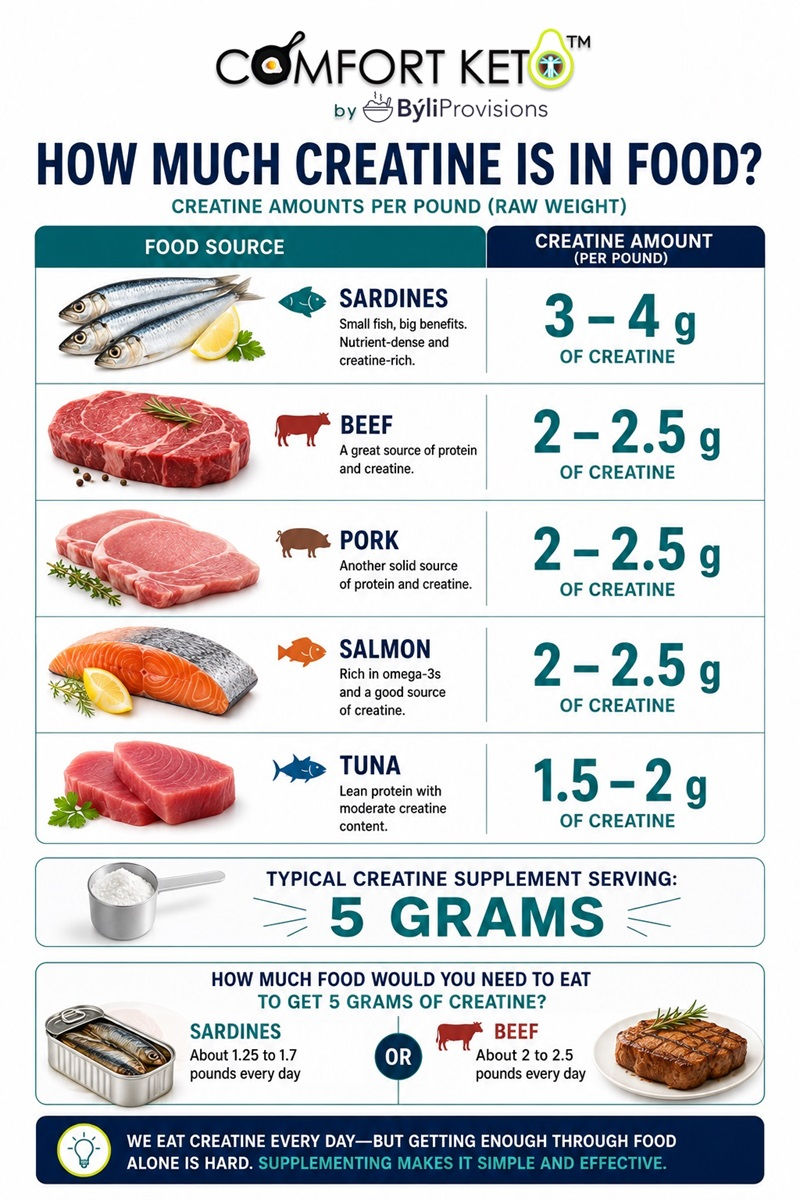
Cooking destroys a portion of naturally occurring creatine, which is one reason supplementation is more practical than attempting to obtain performance-enhancing amounts from food alone.
Is Creatine Safe?
Creatine monohydrate has been studied for more than three decades and has an excellent safety profile in healthy individuals.
Common myths include kidney damage, dehydration, cramping, and hair loss. Large reviews of scientific evidence have failed to support these concerns in healthy people using recommended doses.
Creatine and Staying Strong as We Age
For athletes and active individuals, the benefits of creatine show up as improved performance, faster recovery, increased strength, and greater physical capacity.
As we get older, however, those same benefits become even more meaningful.
Maintaining muscle and strength gradually becomes less about lifting heavier weights or improving athletic performance and more about preserving mobility, independence, and quality of life.
Beginning around age 30, adults gradually begin to lose muscle mass and strength. This process accelerates with age and is one of the reasons many everyday activities become more difficult over time.

Regular physical activity and resistance exercise remain the most effective tools we have for preserving muscle and strength as we age.
Creatine cannot replace movement or exercise, but research consistently shows that it can enhance the benefits of resistance training and help support the preservation of muscle mass and strength over time.
The benefits extend far beyond the gym. Maintaining muscle and strength can help make everyday activities easier and allow people to remain physically capable, mobile, and independent for longer. This includes:
Climbing stairs more comfortably.
Getting up from a chair more easily.
Carrying groceries with less effort.
Lifting grandchildren without strain.
Maintaining balance and stability.
Reducing the risk of falls.
Remaining physically independent later in life.
Continuing to travel, garden, hike, and enjoy favorite activities for longer.
For many older adults, these abilities matter far more than bigger muscles or heavier weights in the gym.
If our bodies make creatine naturally, why supplement at all?
Our ancestors likely had enough creatine to survive and function normally without additional supplementation. Natural creatine production, diets consisting largely of whole foods in their natural state, and physically demanding lifestyles were generally sufficient to maintain muscle health and performance. Modern creatine supplementation aims not to prevent deficiency, but to optimize performance, resilience, and preserve muscle and cognitive function later in life, while helping compensate for some of the realities of modern life, including highly processed diets and significantly reduced levels of daily physical activity.
How Much Creatine Should You Take?
For most people, 3 to 5 grams of creatine monohydrate per day is sufficient.
A traditional loading phase of 20 grams daily for five to seven days can increase muscle creatine levels more quickly, but it is not necessary. People who use the loading phase sometimes feel heavier or fuller during the first week or two of supplementation, which is one reason creatine developed a reputation for causing bloating.
Many people prefer to skip the loading phase and simply take 3 to 5 grams daily, allowing muscles to gradually absorb and store additional creatine over several weeks.
Consistency matters far more than timing.
Note: The vast majority of scientific research on creatine has been conducted using creatine monohydrate. It remains the form with the strongest scientific support and is also typically the most affordable. When people refer to creatine supplementation, they are almost always referring to creatine monohydrate.
Our personal product ranking:
Excellent reputation.
Third-party tested.
Outstanding value for long-term daily use.
Best price: $28.99 @ Muscle & Strength
2. Optimum Nutrition Creatine Powder 60 Servings (300 Grams)
Probably the safest "buy it and forget about it" option.
Uses high-purity creatine monohydrate and has been around for decades.
Mixes well and is widely available.
Best price: $15.99 @ Walmart
Simple and inexpensive.
Great option for someone trying creatine for the first time.
Best price: $23.97 @ Nutricost
Premium product with strong quality controls and transparency practices.
Best price: $12.99 @ Walmart
One additional tip: don't feel pressured to pay extra for products advertising creatine HCL, buffered creatine, liquid creatine, multi-phase transport systems, proprietary blends, gummies, or fancy flavor systems.
Key Takeaway
Creatine is not merely a bodybuilding supplement. Your body already produces and uses creatine every day as part of how it supplies energy to muscles and other demanding tissues.
Taking creatine simply increases the amount available to support strength, performance, recovery, and muscle growth.
For athletes and active individuals, these benefits translate into improved performance, better recovery, and greater physical capacity.
As we get older, these same benefits become increasingly important for preserving mobility, independence, and quality of life.
Creatine is one of the most effective, safest, and thoroughly researched nutritional supplements available.

As a chef, I spend a great deal of time thinking about food, nutrition, and the choices that shape our long-term health and quality of life. The reality is that growing older is inevitable. Becoming weaker, less capable, and less independent doesn't have to be.
Small decisions made consistently over many years determine how we feel, move, and live decades later. If a simple daily habit can help preserve strength, mobility, physical capability, and independence, it is worth considering.
At Comfort Keto, we believe that nutrition should do more than simply help us reach a number on the scale. The real goal is to preserve the physical capability that allows us to continue enjoying the people, places, and experiences that make life meaningful.
Because the goal is not simply to add years to life, but to help add life to those years.
— Chef Janine


Comments